
Article: How to Make Your Home Feel Cosier Without Adding More Clutter
How to Make Your Home Feel Cosier Without Adding More Clutter
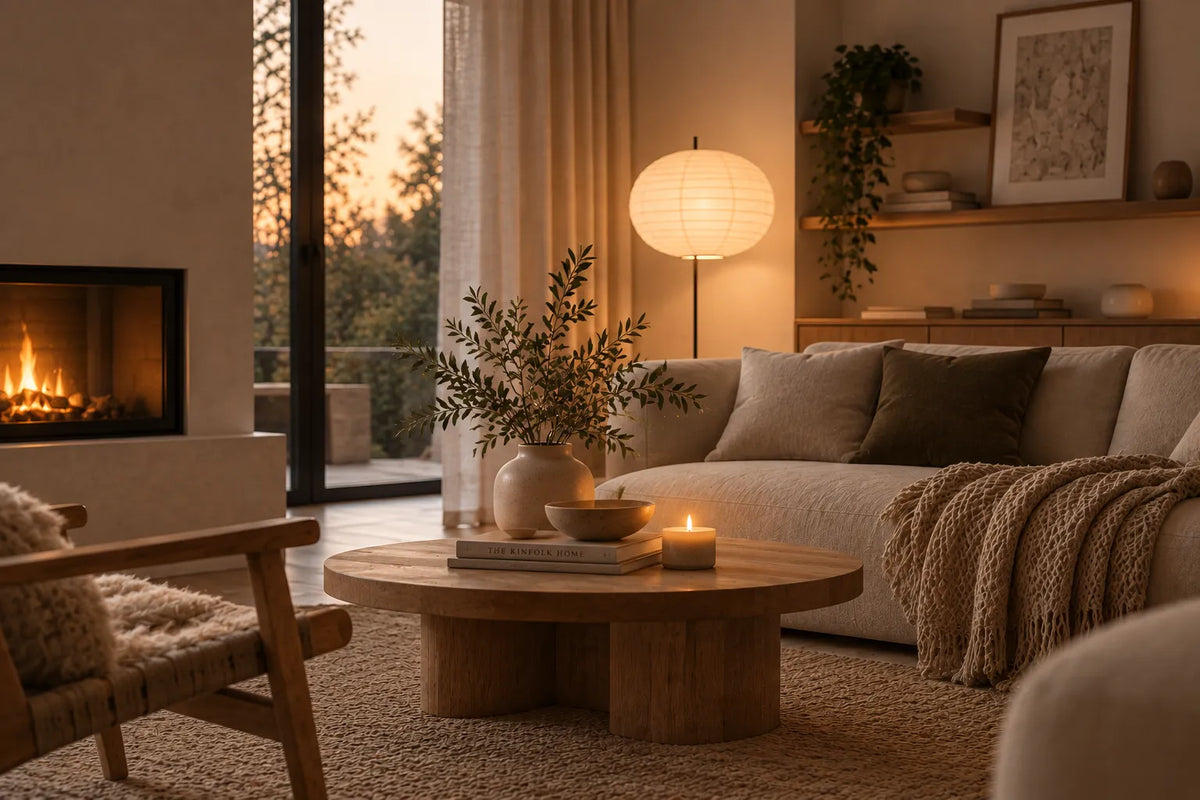
A cosy home doesn't need to be filled with cushions, candles, ornaments and decorative accessories.
In fact, adding more things can sometimes have the opposite effect. A room becomes visually busy, surfaces disappear beneath objects and the sense of calm you were trying to create gets lost.
The Scandinavian approach offers another way.
Instead of creating comfort through more possessions, you can create it through light, texture, warmth, proportion and atmosphere.
If your home feels a little cold or unfinished but you don't want to fill it with more things, these simple changes can make a surprisingly large difference.
1. Start With the Lighting, Not the Decor
Before buying another cushion, vase or decorative object, look at how your room is illuminated.
Lighting has an enormous influence on whether a space feels warm or cold.
One of the most common problems is relying on a single bright ceiling light. It may illuminate the room efficiently, but light coming predominantly from above can make an interior feel flat.
Instead, create several smaller pools of light.
A living room might combine:
- A ceiling or pendant light
- A floor lamp beside the sofa
- A table lamp on a console
- A small accent light in a darker corner
You haven't added clutter. You've changed the depth and atmosphere of the room.
Keldvik tip
Tonight, switch off your main ceiling light and turn on only your smaller lamps.
Look at the room again.
If it immediately feels more comfortable, you probably don't need more decoration. You need better lighting.

2. Choose Warmer Light
The colour of your light matters almost as much as where it comes from.
For living rooms, bedrooms and other spaces designed for relaxation, warm white light around 2700K is an excellent starting point.
It has a softer, slightly warmer appearance than 3000K and can complement wood, linen, stone and neutral colours beautifully.
This is particularly effective in Scandinavian and Japandi interiors, where natural materials are often an important part of the room.
If your home currently feels clinical, check your bulbs before changing anything else.
Replacing cool lighting with warmer bulbs can transform the atmosphere without adding a single new decorative object.
3. Bring Light Down to Eye Level
Ceiling lighting is useful, but cosy rooms rarely rely on it alone.
Lower light naturally creates more intimate areas.
Think about the difference between a brightly illuminated restaurant and a small table lit by a pendant or lamp. The second immediately creates a sense of enclosure and intimacy.
You can use the same principle at home.
A table lamp on a sideboard, a floor lamp beside an armchair or a pendant positioned above a dining table brings the light closer to where life actually happens.
This also creates contrast between brighter and darker areas.
And that contrast is important.
Cosiness doesn't come from making every corner equally bright.
4. Add Texture Instead of More Objects
If a minimalist room feels empty, the instinct is often to decorate it.
Try adding texture instead.
Texture creates visual richness without requiring dozens of individual objects.
Natural materials are particularly effective:
Linen · wool · timber · stone · ceramic · paper · rattan
Imagine two neutral living rooms.
The first contains smooth white walls, a smooth sofa, a smooth coffee table and little else.
The second uses the same neutral palette but combines a linen sofa, wool rug, timber table, ceramic lamp and softly woven curtains.
Neither room needs to contain much.
But the second will usually feel considerably warmer because your eye has more material variation to explore.

5. Let Natural Materials Do the Decorating
One reason Scandinavian and Japandi homes can remain relatively minimal without feeling empty is that the materials themselves provide character.
A beautiful piece of timber doesn't need much decoration placed on top of it.
Stone has natural variation.
Linen has movement.
Hand-finished ceramic has subtle irregularities.
A woven lampshade changes throughout the day as sunlight and artificial light pass across it.
Instead of asking:
“What can I put here?”
try asking:
“Is the material itself interesting enough?”
Sometimes the answer is yes.
6. Use Empty Space Deliberately
Empty space isn't necessarily unfinished space.
It gives your eye somewhere to rest.
This principle is particularly important if you want a cosy minimalist home rather than one that gradually becomes filled with decorative objects.
You don't need something in every corner.
You don't need artwork on every wall.
And you certainly don't need to fill every centimetre of a shelf.
Allow important objects to have space around them.
A single sculptural lamp on a console can have considerably more presence than the same lamp surrounded by six smaller accessories.
In Scandinavian and Japandi interiors, this breathing room is part of the composition.
7. Create One Cosy Focal Point
Instead of trying to make the entire room feel cosier at once, concentrate on one place where you naturally spend time.
Perhaps it's the end of your sofa.
An armchair near the window.
Your dining table.
A bedside table.
Start there.
For a reading corner, for example, you might need only:
a comfortable chair + a warm floor lamp + a small surface for a book or cup.
That's enough to establish a destination within the room.
Once one area feels inviting, the rest of the space often starts to make more sense.

8. Soften Hard Surfaces
Modern homes often contain many hard surfaces: painted walls, glass, stone, televisions, cabinetry and hard flooring.
You don't need to cover them with decorations.
Instead, introduce a few larger soft elements.
A rug can transform a seating area.
Curtains can soften an entire wall.
One generous throw can introduce more warmth than five decorative accessories.
The key is scale.
Rather than adding lots of small objects, use fewer, larger elements that make a meaningful difference to the room.
This keeps the space visually quiet while making it physically and visually softer.
9. Use a Warm, Tonal Colour Palette
A cosy room doesn't need to be dark.
Warm neutrals can create an inviting atmosphere while preserving the lightness associated with Scandinavian interiors.
Consider shades such as:
- Warm white
- Ivory
- Sand
- Oatmeal
- Mushroom
- Taupe
- Warm grey
- Muted brown
Instead of introducing many different colours, create depth through variations of similar tones.
For example, cream walls, an oatmeal sofa, beige rug and pale timber furniture can create a layered room without becoming visually complicated.
Small amounts of darker brown, charcoal or black can then provide definition.
10. Pay Attention to the Corners
Sometimes a room feels uncomfortable because the centre is brightly illuminated while everything around it disappears.
You don't necessarily need to decorate those corners.
Try lighting one.
A small table lamp, wall light or floor lamp can visually extend the room and make it feel more balanced.
This is especially useful in the evening.
Your eye sees several warm points throughout the space rather than one bright area surrounded by darkness.
The result can make the entire room feel more intimate.

11. Hide What Doesn't Need to Be Seen
Making a home feel cosier isn't only about what you add.
It's also about what you remove from view.
Cables, chargers, packaging, paperwork, remote controls and miscellaneous everyday objects can create visual noise even when a room is technically tidy.
Closed storage is incredibly useful in minimalist interiors because it allows the objects you intentionally display to have more impact.
Try clearing just one surface completely.
Then return only the things that either serve a function or genuinely contribute to the room.
You may be surprised by how little needs to come back.
12. Create an Evening Version of Your Home
Your home doesn't have to look and feel the same throughout the day.
During daylight hours, open the curtains and make the most of natural light.
As evening arrives, change the atmosphere.
- Switch off unnecessary overhead lights.
- Turn on table and floor lamps.
- Dim the dining pendant.
- Close the curtains.
- Let some areas become darker.
This transition can become a small daily ritual.
It's also one of the simplest ways to bring some of the feeling associated with Scandinavian hygge into your home without buying anything.
The room hasn't changed.
The atmosphere has.
Cosy Doesn't Mean Full
There is an important distinction between a room feeling cosy and a room feeling full.
Cosiness comes from comfort, warmth, softness, familiarity and the way a space makes you feel.
None of those things require shelves filled with objects.
A quiet room with warm lighting, natural timber, a soft rug and somewhere comfortable to sit can feel far more inviting than a heavily decorated one.
This is where Scandinavian and Japandi interiors have something particularly useful to teach us:
Warmth and simplicity aren't opposites.
They can strengthen one another.
A Simple Cosy-Home Reset
Before buying anything new, try this tonight:
- Clear one visually busy surface.
- Switch off your brightest overhead light.
- Turn on two or three smaller lamps.
- Move one lamp closer to where you actually sit.
- Check whether your bulbs are warm white.
- Add one existing blanket or textile where you spend the evening.
- Leave at least one area deliberately empty.
Then spend an evening with the room before deciding whether anything is missing.
You may find that what your home needed wasn't another object.
It simply needed a little less visual noise and a little more warmth.

